
Your landed cost after de minimis is now the number that decides whether a shipment makes money.
The 800 dollar de minimis exemption is gone. Shipments that used to clear US customs duty free now pay country-specific tariffs, and from 24 July 2026 low-value postal shipments face a new entry process requiring 10-digit HTSUS codes, a continuous bond, and a monthly duty worksheet. If you import, your landed cost changed and your cash cycle changed with it.
In this article
What changed, and when
De minimis let shipments under 800 dollars enter the United States free of duty with minimal paperwork. It was used roughly 1.4 billion times in a single year. It ended for goods originating in China and Hong Kong on 2 May 2025, and for all remaining countries on 29 August 2025.
Goods that previously entered under Section 321 without duty assessment are now subject to applicable tariffs, taxes and fees. There is no value floor any more. A 200 dollar parcel and a 20,000 dollar pallet are treated on the same principle, differing only in entry type and paperwork burden.
How to calculate your landed cost after de minimis
Landed cost is now product cost, plus freight and insurance, plus duty at the country-specific rate, plus the merchandise processing fee and any harbour maintenance fee, plus customs brokerage, plus the amortised cost of your bond. For many importers who previously shipped in small parcels, the duty line alone moves gross margin by several points.
The country of origin now matters as much as the supplier price. Two identical products from two countries are no longer the same product once tariffs are applied. If you are re-quoting suppliers this quarter, quote them landed rather than ex-works, or you will be comparing numbers that are not comparable.
The 24 July 2026 postal deadline
Two further changes are already scheduled. From 28 February 2026, all postal shipments must use the ad valorem duty method, ending the temporary flat specific-duty option. From 24 July 2026, low-value mail shipments must move to a new postal entry process.
That new process requires three things many small importers do not currently have: 10-digit HTSUS classification for every item, a continuous customs bond, and a monthly International Mail Duty Worksheet submission. If you have been relying on postal channels to avoid formal entry, that route is closing.
The part nobody budgets for: cash flow
Duty is payable at entry. Your customer pays you on your normal terms, which for most wholesalers is 30 days or worse. That gap is the real cost of the change, and it is a working capital problem rather than a customs problem.
An importer bringing in 400,000 dollars of goods a month at an average 12 percent effective duty rate needs roughly 48,000 dollars of additional cash deployed every month before a single invoice is collected. Nothing about the goods changed. The timing of the outflow did.
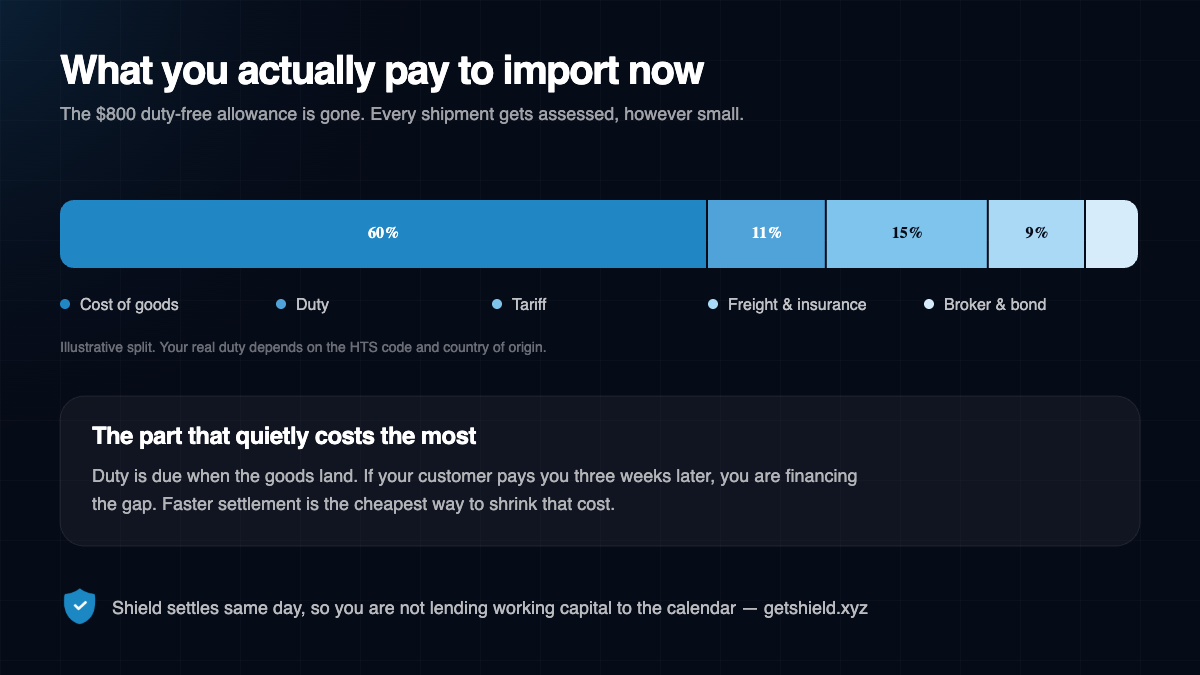
This is why settlement speed has become a margin issue and not just a convenience. Every day between shipment and collected funds is a day that duty money is tied up. Businesses collecting in stablecoin and settling same day, rather than waiting on multi-day wires, recover that working capital faster. We covered the mechanics in USDT payments for wholesalers.
What to do before the deadline
Most of what follows is your customs broker’s job, not yours. It is here so you know what good looks like and can tell whether yours is on top of it.
Classify your catalogue properly. You need 10-digit HTSUS codes, not the 6-digit approximations many suppliers provide. Getting this wrong means delays and potential penalties, and it is the single biggest source of avoidable cost.
Get a continuous bond if you file with any frequency. Single transaction bonds become expensive quickly and will not satisfy the new postal process. Talk to your broker about coverage limits now rather than in July.
Re-quote your landed costs by origin country and reprice accordingly. Then look at your cash conversion cycle honestly: if duty is now due weeks before your customers pay, either your terms change, your financing changes, or your settlement speed does.
The money side is ours. We settle in dollars the same day your buyer pays, so the cash to cover duty is in your account before it is due rather than three weeks after. You do not need to learn anything new to make that work. Talk to us and we will set it up.
Where this leaves importers
The end of de minimis removed a structural advantage that direct-from-factory sellers enjoyed for a decade, which is genuinely good news if you hold inventory in the United States. But it moved cash out of your business earlier in the cycle. Importers who reprice by origin, classify correctly, and shorten the time between shipment and collected funds will absorb it. Those who only discover it through their broker in July will not.
Keep reading
- USDT payments for wholesalers: getting paid in USD
- LATAM cross-border payments: why buyers prefer USDT
- 3 steps to accepting payments from international clients