
Is Shield safe? If you’re moving real money through Shield — paying suppliers, holding operating cash — you should know exactly where it sits and what keeps it safe. Here’s the straight version.
Why is Shield safe? It’s federally regulated
Shield is a registered money service business. That’s a FinCEN regulation under the US Treasury. It means we’re required to report transactions, we have to take real measures to prevent money laundering, and we’re held accountable at the federal level to fulfill our transactions. This isn’t optional for us. It’s the law.
Where your money actually sits
When you open a Shield account, you get two things: a bank account and a wallet.
The bank account comes through our banking partners — Cross River or Lead Bank. Both are FDIC-insured banks. Your money sits in a real bank account at a real insured bank.
The wallet is a secure address you can share with your customers to accept funds. Our custodial partners hold those wallets, and they carry large insurance policies of their own.
How money from abroad reaches your bank account
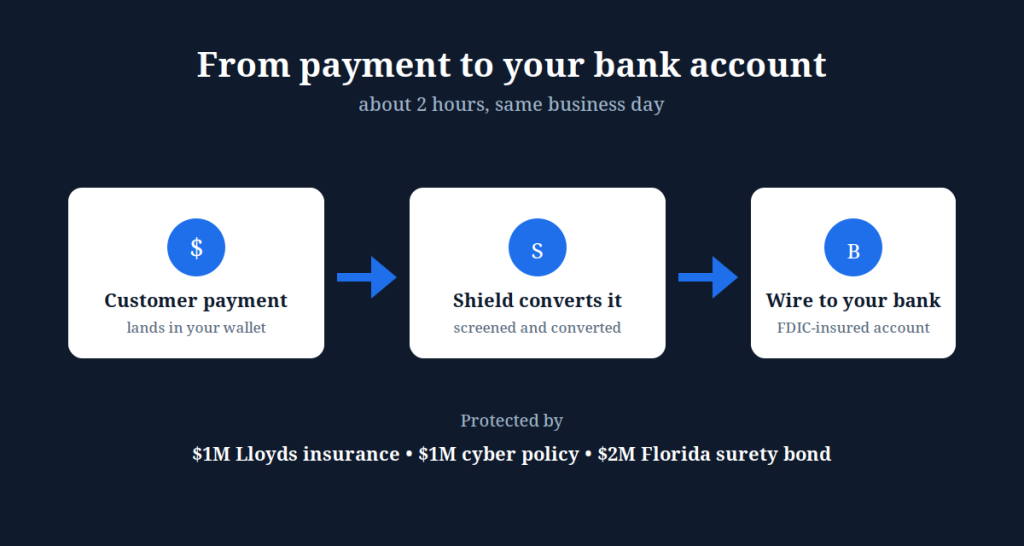
A lot of our customers have buyers in other countries who pay with digital currencies. Shield lets you accept those payments and receive the money in your bank account: the payment comes into your wallet, and we instantly convert it into a wire sent to your bank.
From the moment the payment arrives to the moment the wire lands in your bank, it usually takes about two hours. We say same business day to be safe. In practice, it’s about two hours.
Is Shield safe? What protects you if something goes wrong
Fair question. If ‘is Shield safe’ is what you’re really asking, here’s what’s in place:
- A $1M insurance policy with Lloyds of London covering D&O, E&O, and commercial crime. If someone on our team makes a mistake, or criminals try social engineering against us, this policy protects you.
- A $1M cyber risk policy. If there’s ever a hack or an exploit, you’re covered up to a million dollars.
- A $2M surety bond in the state of Florida. If Shield ever failed to complete its contracts or caused you financial losses, the bond pays claims up to two million dollars.
How we keep dirty money away from your business
Every transaction gets screened before money moves — on both the digital side and the dollar side.
On the digital side, we use the same tracing tools that investigators and private detectives use. Every transaction gets scanned for exposure to tainted funds: money tied to laundering, scams, or exploits. High-risk transactions get rejected outright. Low-risk ones pass through. Medium-risk ones get manual review. We ask questions, request information, and only then decide to accept or reject.
On the dollar side, we run monitoring software that looks for strange patterns. Accounts showing abnormal activity get offloaded. We don’t wait around on that.
What about all the negative stories about digital assets?
Fair question, and you’re right to ask — especially if headlines have you wondering ‘is Shield safe.’ Those stories are almost always about speculation: platforms gambling on prices, investing customer money, making bets.
Shield doesn’t do any of that. We’re a payments company. We move US dollar-denominated payments across borders for real trade — physical goods moving between countries. Your money isn’t invested, isn’t traded, isn’t bet on anything. It moves from your customer’s payment to your bank account, and that’s the whole story — the plain answer to ‘is Shield safe’.