US business bank account non-resident: you can open one, and in most cases you do not need to fly to the United States to do it. What you do need is a clear answer to one question: are you forming a US entity, or do you want US account details in your existing company name? Those are two different products, with different paperwork and different timelines.
This US business bank account non-resident guide covers both routes in detail.
In this article
The two routes, and which one you need
Most guides tell you to register a Delaware or Wyoming LLC, get an EIN, then apply to a US fintech. That works, and for some businesses it is the right answer. But it adds a US tax filing obligation, a registered agent cost, and a compliance surface you may not want.
The second route is less well known: keep trading through your existing foreign company and obtain US account and routing numbers in that entity name. For an importer in Bogota or an exporter in Dubai who needs to receive USD from American buyers, this avoids creating a US taxpayer where none is needed.
Pick route one if you plan to hire in the US, hold US inventory, or raise from US investors. Pick route two if the goal is purely to send and receive dollars.
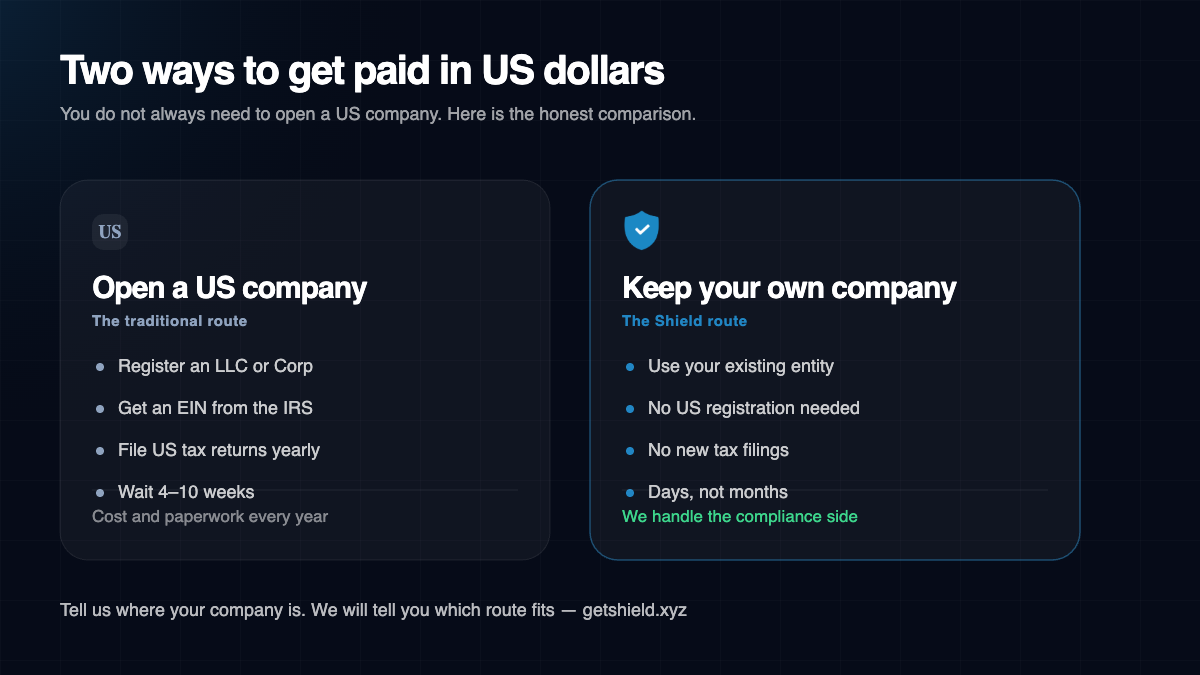
If you are not sure which one you are, you do not need to decide alone. Tell us where your company is registered and who your buyers are, and we will tell you which route fits and what it will take. That conversation costs nothing and takes about ten minutes.
What you will actually be asked for
Both routes involve the same background check on your business, usually called KYB, or know your business. Expect to provide formation documents for your company, proof of good standing, the business address, a description of what you actually sell, and expected monthly volume. You will also identify every beneficial owner at 25 percent or more, plus directors and authorised users, each with identity documents.
Two items trip up more applications than anything else. The first is proof of address that matches the documents exactly. The second is a coherent explanation of your money flow: who pays you, from which country, in what currency, and against what invoices. Have that written down before you start.
Route 1: form a US entity
Registering an LLC takes a few days in most states. The EIN is the bottleneck. With a US-resident responsible party holding a Social Security number, an EIN can be issued quickly online. Without one, you file Form SS-4 by fax or mail and wait, typically several weeks.
Once you have the EIN and formation documents, US fintech accounts are usually straightforward. The trade-off is ongoing: annual state filings, a registered agent, and US federal filings even in years when the entity earns nothing. Budget for an accountant who understands foreign-owned single-member LLCs.
Route 2: keep your home entity
This is the route Shield was built for. Your existing company completes KYB, and you receive US account and routing details capable of accepting domestic wires and ACH, without forming a US entity. Buyers pay you the way they pay any American supplier.
It matters commercially for the reason discussed in why LATAM buyers prefer paying in USDT: friction on the buyer side loses orders. A US buyer sending a domestic wire behaves differently from one wrestling with an international transfer, and a Latin American buyer holding dollars in stablecoin behaves differently again. Supporting both is what keeps deals from stalling.
Why applications get rejected
Vague business descriptions are the most common cause. Compliance teams need to understand what you sell and to whom. Second is a mismatch between stated volume and documentation, where an applicant claims half a million dollars a month but supplies no invoices or bank statements. Third is a restricted industry, worth checking before you apply rather than after.
If you expect to receive stablecoin as well as wires, say so upfront. Providers who cannot support it should screen you out early, and providers who can will want your wallet addresses for screening. Hiding the flow and having it surface later is what gets accounts closed.
US business bank account non-resident: which route to pick
US business bank account non-resident: opening one is a documentation exercise, not a legal obstacle. Decide first whether you need a US entity at all. If the goal is simply to get paid in dollars by international buyers, the faster path is to keep your existing company and get US account details in its name.
Keep reading
- USDT payments for wholesalers: getting paid in USD
- The 3 eras of banking for global trade
- 3 steps to accepting payments from international clients
Sources
- IRS, how to apply for an EIN
- FinCEN, beneficial ownership information reporting
- International Trade Administration, country commercial guides
Opening the account is one thing, trusting who holds it is another. Here is who is behind Shield.